





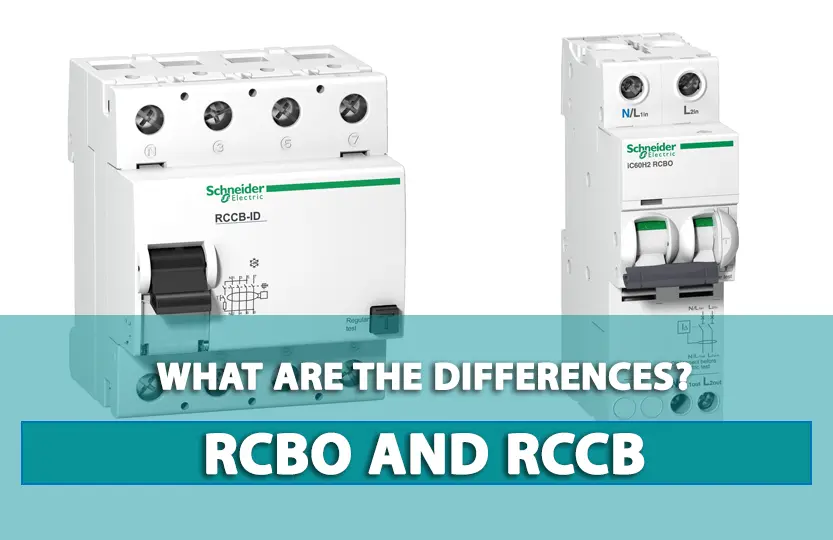
When it comes to electrical safety, circuit breakers play a vital role. Among the commonly used circuit breakers are RCBO and RCCB, which offer protection for devices, circuits, and individuals by monitoring current flow.
Nonetheless, distinguishing between RCBO and RCCB can be challenging for many. This comprehensive guide aims to shed light on the differences between RCBO and RCCB, empowering you to choose the most suitable option for your specific requirements.
RCBO vs RCCB Comparison: Protecting Against Earth Faults & Overcurrent
| Feature | RCCB (Residual Current Circuit Breaker) | RCBO (Residual Current Circuit Breaker with Overcurrent Protection) |
|---|---|---|
| Main Function | Protects against earth leakage (residual current) | Protects against both earth leakage and overcurrent |
| Overcurrent Protection | ❌ No | ✅ Yes |
| Earth Leakage Protection | ✅ Yes | ✅ Yes |
| Short Circuit Protection | ❌ No | ✅ Yes |
| Poles | 2-pole (single-phase) or 4-pole (three-phase) | Typically 1, 2, or 4-pole; acts like MCB with leakage detection |
| Type of Current Detected | AC, AC/DC, Type F or B (depending on RCCB type) | AC and DC (also protects against overcurrent and short circuits) |
| Application | Residential and industrial systems for human safety | Residential and industrial systems for complete protection of equipment and people |
| Cost | Lower | Higher |
| Important Note | Only cuts leakage current; usually combined with MCB for full protection | Combines RCCB and MCB functionality; no separate device needed |
What is a Residual Current Circuit Breaker (RCCB)?
A residual current circuit breaker (RCCB) is a crucial safety tool in electrical systems, designed to identify and interrupt electrical circuits in cases of leakage current. By swiftly interrupting the circuit, RCCBs prevent potential fires and safeguard individuals from dangerous electric shocks.

Working Principle of RCCB
The operation of an RCCB is rooted in Kirchhoff’s current law, which dictates that the total current entering a node must equal the total current exiting the node. Under normal circumstances, the currents through the live and neutral wires should be balanced and equal but opposite.
Nevertheless, in faulty conditions, an imbalance in the live and neutral currents, known as residual currents, occurs. For instance, when a person comes into contact with a live wire, a portion of the current may disperse to the ground through an alternate route. This divergence is precisely what an RCCB identifies and swiftly triggers the circuit interruption within milliseconds.
Main Function of RCCB
The primary role of an RCCB is to offer earth fault protection by constantly monitoring the disparity in current levels between the live and neutral wires. If the residual current stemming from a fault surpasses set thresholds, the RCCB swiftly interrupts the circuit, thereby safeguarding against electric shocks and potential hazards.
Types of RCCB (Residual Current Circuit Breakers)
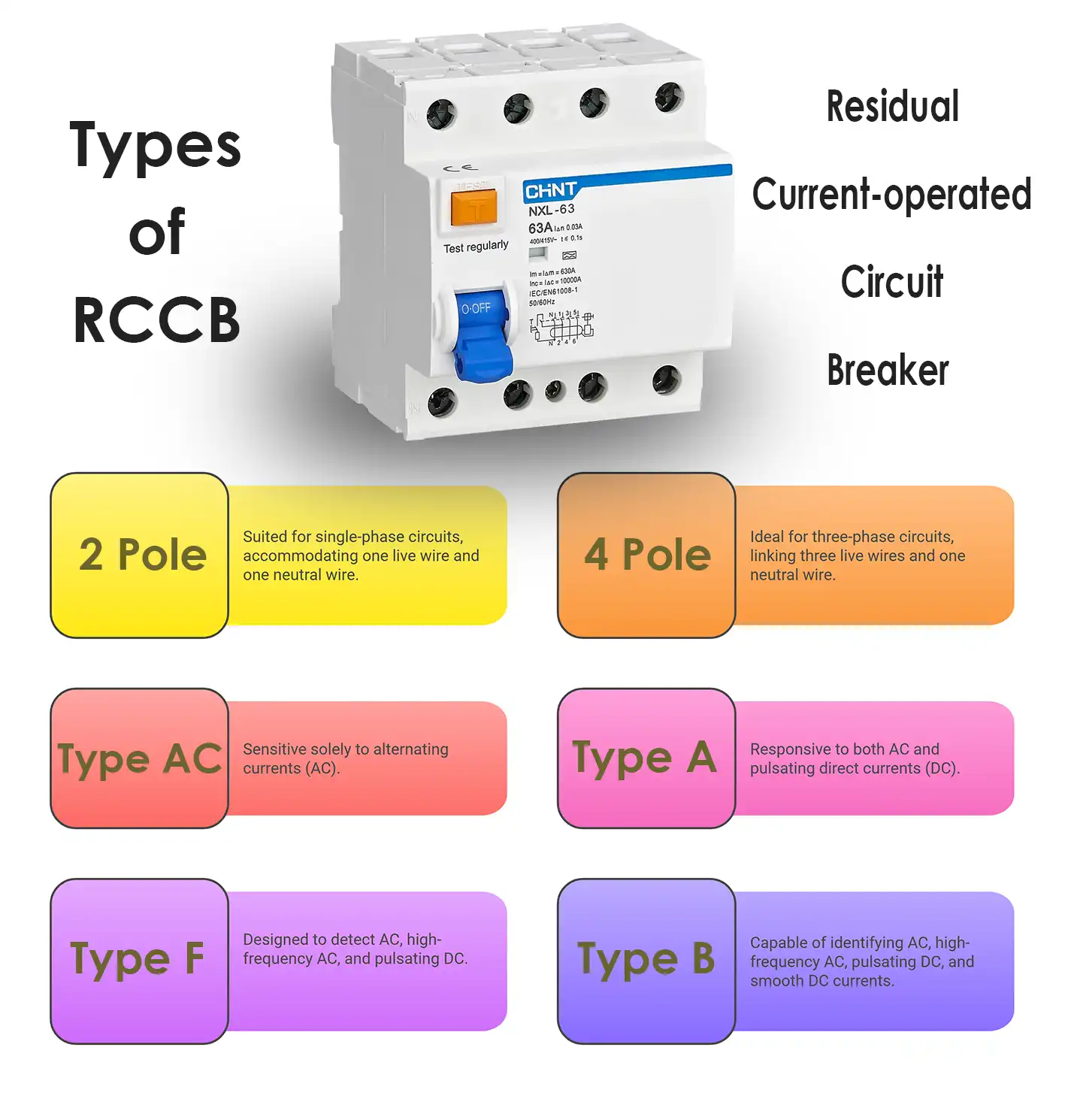
Residual Current Circuit Breakers (RCCBs) are essential components in modern electrical systems, designed to protect human life and equipment by detecting leakage currents and disconnecting the circuit when necessary. RCCBs are available in different types based on their pole configuration and sensitivity to various types of currents. Understanding these types is crucial for selecting the right RCCB for specific applications—whether in residential, commercial, or industrial environments.
2 Pole RCCB
The 2-pole RCCB is primarily used in single-phase electrical systems. It includes one live (phase) wire and one neutral wire. This type is ideal for protecting standard home circuits and small-scale installations. It offers reliable leakage protection for basic lighting, sockets, and small appliances.
4 Pole RCCB
The 4-pole RCCB is designed for three-phase electrical systems, where it can monitor and protect circuits carrying three live wires and one neutral wire. It is typically used in industrial and commercial setups where high loads are distributed across multiple phases, ensuring comprehensive protection.
RCCB Types Based on Sensitivity
Type AC RCCB
This is the most basic type of RCCB. It is sensitive only to alternating currents (AC). Type AC RCCBs are suitable for simple residential circuits without electronic devices that may generate DC components.
Type A RCCB
Type A RCCBs detect both alternating current (AC) and pulsating direct current (DC). They are recommended for use with modern appliances such as washing machines, induction hobs, or LED lighting systems, which can produce residual DC currents.
Type F RCCB
Type F RCCBs are more advanced and can sense AC, high-frequency AC, and pulsating DC currents. These breakers are commonly used with devices like inverter-driven washing machines, air conditioners, and certain motor controls that operate with variable frequencies.
Type B RCCB
Type B RCCBs offer the highest level of protection, detecting pure DC currents, in addition to AC, high-frequency AC, and pulsating DC. They are essential in systems where smooth DC leakage might occur—such as in EV chargers, photovoltaic (solar) systems, industrial drives, and UPS systems.
Each type of RCCB serves a unique purpose in ensuring safety and functionality in an electrical system. When choosing the right RCCB, consider the type of load, the nature of the current, and the overall safety requirements of the environment.
What is a Residual Current-operated Circuit Breaker (RCBO)?
In the realm of electrical protection devices, RCBO – Residual Current Circuit Breaker with Overcurrent Protection – offers enhanced safety features compared to RCCBs. RCBOs safeguard against both residual current faults and overloads, boosting protection against short circuits as well.
Working Principle of RCBO
The operational mechanism of an RCBO in detecting earth leakage aligns with Kirchhoff’s principle, ensuring equilibrium between incoming and outgoing currents. By continuously monitoring disparities in current between live and neutral lines, an RCBO severs the circuit upon detecting a variance beyond preset safety limits.
Similar to standard MCBs, the functionality of an RCBO in responding to overcurrent is primarily governed by electromagnetic induction and the utilization of bimetallic strips. In instances of short circuits, the electromagnetic trip coil within the RCBO promptly triggers to deactivate the circuit.
Additionally, in cases of electrical overload from connected devices, the bimetallic strip flexes to initiate the circuit breaker’s trip mechanism.
Main Functions of RCBO
The operational principle of an RCBO underscores three key functions:
1. Shielding against earth fault currents
2. Safeguarding against overcurrent caused by overloading
3. Defense against short circuit currents
In essence, an RCBO serves as a comprehensive multifunctional device designed to safeguard both domestic and industrial electrical systems against a range of potential electrical faults and hazards.
RCBO and RCCB: Key Differences
Reviewing the fundamental disparities between RCBOs and RCCBs highlights the superior protective capabilities of RCBOs over RCCBs. While a RCBO defends against both earth faults and overcurrent, an RCCB solely guards against earth faults.
In addition, typically, an RCBO incurs a higher initial investment in comparison to an RCCB. This leads many individuals to opt for connecting an RCCB to an MCB to achieve a similar level of protection as offered by an RCBO.
Conclusion
RCBO and RCCB serve as popular circuit breakers widely utilized in various applications. From the detailed comparison provided above, it is apparent that an RCBO safeguards against both earth faults (residual current) and overcurrent, whereas an RCCB focuses solely on earth leakage protection.
Nonetheless, when choosing between circuit breakers, factors such as budget and compatibility with existing systems should also be taken into consideration.