





How to Read the Nameplate of a Miniature Circuit Breaker (MCB) for Accurate Installation
To explore a wide range of industrial MCB options, including the Schneider Acti 9 series, click here.
A miniature circuit breaker (MCB) is an essential protective device used across residential, commercial, and industrial electrical installations. It safeguards circuits from overload, short-circuit faults, and also acts as a manual load switch.
For electricians, engineers, and even homeowners, the ability to accurately read an MCB nameplate ensures safe installation, proper coordination, and long-term reliability of the electrical system.
If you’re exploring high-quality industrial MCB options such as the Acti 9 series from Schneider Electric or compact models from Siemens, understanding nameplate markings is the first step toward selecting the right device.
Why Understanding the MCB Nameplate Matters
The MCB nameplate includes crucial specifications required to match the device with the circuit it protects. Incorrect interpretation can lead to:
Inadequate protection
Frequent tripping
Overheating and wiring damage
Failure during high fault currents
Long-term safety hazards
Correctly reading the nameplate ensures that the MCB aligns with:
Rated voltage (Ue)
Rated current (In)
Breaking capacity (Icu or Icn)
Tripping characteristics (B, C, D curves)
Both installers and end-users benefit from understanding these details when maintaining or upgrading electrical panels.
MCB Nameplate Information — Complete Breakdown
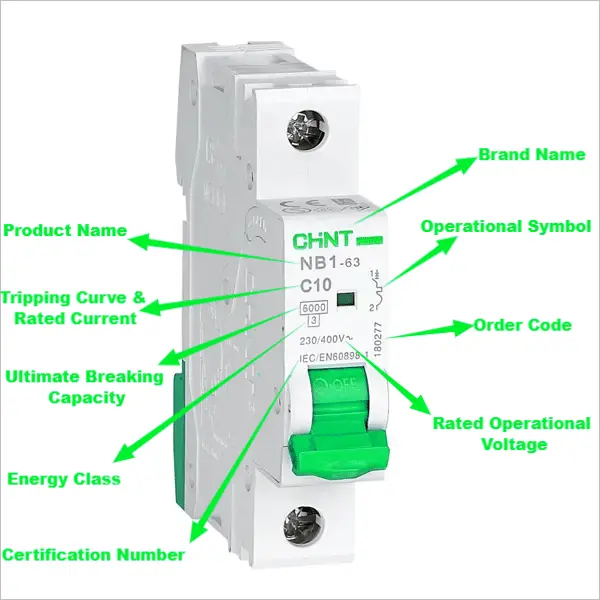
Below is an updated and expanded explanation of common nameplate elements found on modern MCBs:
1. Brand Name
Located typically on the upper-left corner, the brand label identifies the manufacturer—e.g., Siemens, Schneider Electric, or other certified producers.
This ensures traceability, warranty authentication, and access to technical documentation.
2. Product Model or Series Code
Example: NB1-63
This alphanumeric code specifies the exact model, making it easier to:
Look up technical datasheets
Identify compatible accessories
Order replacements
3. Order Code / Catalogue Number
Often located vertically on the right-hand side (e.g., 180277).
This enables seamless reordering and inventory management for wholesalers, panel builders, and contractors.
4. Tripping Curve & Rated Current (e.g., C10)
Curve Letter (B, C, or D) determines trip characteristics:
B Curve: residential/light loads
C Curve: commercial & industrial loads
D Curve: motor loads & high inrush currents
Number (10) indicates rated current, meaning this device protects circuits up to 10A.
5. Rated Operational Voltage (Ue)
Example: 230/400V
This specifies the voltage the MCB can safely interrupt under normal and fault conditions, covering:
Single-phase (230V)
Three-phase (400V) systems
6. Ultimate Breaking Capacity (Icu / Icn)
Example: 6000A (6kA)
This is the maximum short-circuit current the MCB can safely interrupt without damage.
Choosing an MCB with insufficient breaking capacity may lead to catastrophic failure during faults.
7. Energy Limitation Class (Class 1, 2, or 3)
Example: Class 3
Indicates arc energy limitation performance.
A higher class (like 3) means:
Better arc suppression
Reduced thermal stress
Higher overall safety
8. Certification / Compliance Standards
Example: IEC/EN 60898-1
This certifies that the MCB meets international standards for:
Construction
Performance testing
Electrical safety
Ensuring global compatibility and regulatory approval.
9. Mechanical ON/OFF Status Symbol
A visual indicator on the side or front of the MCB used to quickly check whether:
The circuit is energized
The breaker is in OFF/isolated condition
Useful for maintenance and troubleshooting.
Key Features of Siemens and Schneider MCBs
Siemens Miniature Circuit Breaker Features
High-quality engineering and long service life
Compact footprint to save panel space
Wide current range for versatile applications
Excellent short-circuit protection
Fast installation and simplified maintenance
Trusted performance in industrial and commercial environments
Siemens Miniature Circuit Breaker
Schneider Electric Miniature Circuit Breaker Features
Space-efficient compact design
High breaking capacity for demanding loads
Reliable tripping mechanism for safety
Easy mounting on modern distribution boards
Extensive current and curve range (B, C, D)
Durable design for continuous operation
Schneider Miniature Circuit Breaker
Conclusion
Understanding MCB nameplate markings is essential for ensuring accurate selection, safe installation, and reliable circuit protection.
With decades of expertise in energy technology, both Siemens and Schneider Electric deliver high-performance MCBs trusted worldwide.
Whether you are a homeowner, technician, or electrical engineer, choosing the right MCB ensures:
Safe power distribution
Protection against overloads
Prevention of short-circuit hazards
Long-term reliability
To explore the full range of MCBs and power distribution equipment from Siemens and Schneider, visit GeeTech Group for expert support and worldwide supply.
Frequently Asked Questions
How to Read the Numbers on a Circuit Breaker?
✅ The numbers on a circuit breaker indicate how much electrical current (measured in amps) can pass through the circuit before the breaker trips. For example, a breaker labeled "15" allows 15 amps to flow, but will cut off the circuit if it detects 16 amps or more. This is a critical safety feature designed to prevent electrical overloads.
Understanding the Numbers on MCBs: What Do kA Ratings Mean?
✅ The numbers on a Miniature Circuit Breaker (MCB) represent its Short Circuit Rating, measured in kiloamperes (kA). In domestic installations, MCBs are typically rated at 6kA (6000 amps). This rating indicates the maximum short circuit current the MCB can safely interrupt. Given the standard household voltage of 240V, the over-current in a typical short-circuit scenario should not exceed 6000 amps to ensure protection against electrical hazards.
How to Read an MCCB? Key Features and Ratings Explained
✅ 1. Rated Current (In): This represents the tripping point of the MCCB during overload protection. It defines the maximum current that can flow without tripping.
✅ 2. Rated Frame Current (Inm): The maximum current the MCCB can handle under normal conditions.
✅ 3. Rated Working Voltage (Ue): The voltage rating for continuous operation of the MCCB, indicating the safe voltage range for its regular use.
How to Identify Different Types of Circuit Breakers?
✅ To determine what type of circuit breaker you have, follow these steps:
1. Check the Label: Look at the label on the circuit breaker box. If it's not visible on the exterior, open the panel door and look for the label inside.
2. Find Manufacturer Information: The label should include the manufacturer’s name, model number, and key specifications of the breaker.
If no label is present, you may need to consult an electrician for further identification.