





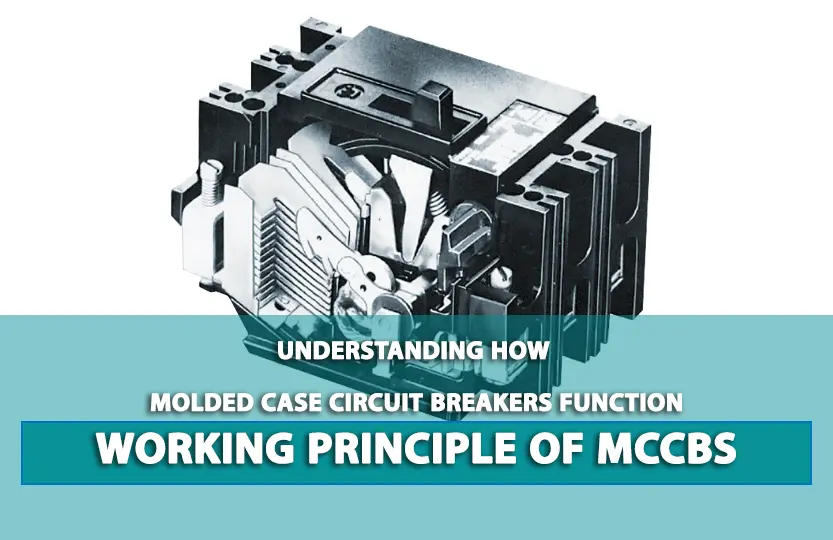
Molded Case Circuit Breakers (MCCBs) are among the most essential protective devices in modern electrical systems. With increasing demand for electrical reliability in 2026, understanding the working principle of MCCB, its construction, internal components, circuit diagrams, and the different tripping characteristics has become more important than ever.
This article is designed for students, engineers, technicians, and anyone interested in understanding how MCCBs protect circuits against overloads and short circuits.
Whether you’re an electrical engineer or just interested in electrical components, this guide will help you understand the fundamental operation and applications of MCCBs, including popular models like Schneider MCCB and Siemens MCCB.
What is an MCCB (Molded Case Circuit Breaker)?
An MCCB or Molded Case Circuit Breaker is a protective device used in low-voltage systems to safeguard circuits from:
Overloads
Short circuits
Ground faults (in advanced models)
Manual switching and isolation
Unlike older protection devices such as fuses, MCCBs are:
Resettable
Adjustable
More durable
Highly reliable
Suitable for higher current ratings
MCCBs are used widely in:
Residential power panels
Commercial electrical distribution
Industrial machines and heavy motors
Smart building safety systems
Major global manufacturers include Schneider Electric, Siemens, Eaton, ABB, LS, and Mitsubishi.
Primary Function of MCCB in Circuit Protection
The primary purpose of an MCCB is simple:
To automatically disconnect the electrical circuit when the current exceeds a safe limit.
MCCBs provide two core protections:
1. Overload Protection (Thermal Trip)
Occurs when current exceeds rated value for a long duration
A bimetal strip heats up and bends
This bending triggers the trip mechanism
2. Short Circuit Protection (Magnetic Trip)
Happens when extremely high fault current flows
A magnetic coil (solenoid) generates strong flux instantly
This triggers rapid disconnection (within 2–5 ms)
Thanks to this dual feature, MCCBs can protect circuits from both slow-rising overloads and sudden short-circuit faults.
Key Functions of MCCBs:
Molded Case Circuit Breakers (MCCBs) perform several essential functions to protect electrical circuits and ensure safety:
1. Overload Protection
Overloading occurs when the current exceeds a preset limit for a certain period, potentially damaging equipment and causing fire hazards. MCCBs detect this condition using a bimetallic strip that trips the breaker to disconnect the circuit automatically.
2. Short Circuit Protection
A short circuit happens when live wires touch each other or a neutral wire, causing a sudden surge of very high current. MCCBs can interrupt short circuit currents up to 200,000 amps within milliseconds (around 0.04 seconds), minimizing damage to electrical systems.
3. Manual Switching
MCCBs also allow manual switching to turn ON or OFF the power supply to connected circuits, which is useful during maintenance or emergency shutdowns.
4. Adjustable Trip Settings
Many MCCBs come with adjustable trip settings, enabling customization of protection thresholds based on the needs of the specific electrical installation.
By combining these features, MCCBs provide reliable protection and operational control, making them vital components in residential, commercial, and industrial electrical systems.
Molded Case Circuit Breaker Working Principle
What is the Working Principle of MCCB?
At its core, the working principle of an MCCB is straightforward. When an overcurrent or short circuit occurs in an electrical circuit, the MCCB detects the fault and automatically interrupts the flow of current. This action helps to prevent damage to the circuit and the connected electrical devices, as well as ensuring the safety of the personnel operating the system. In industrial applications, models such as Schneider MCCB and Siemens MCCB are widely trusted for their reliability and performance.
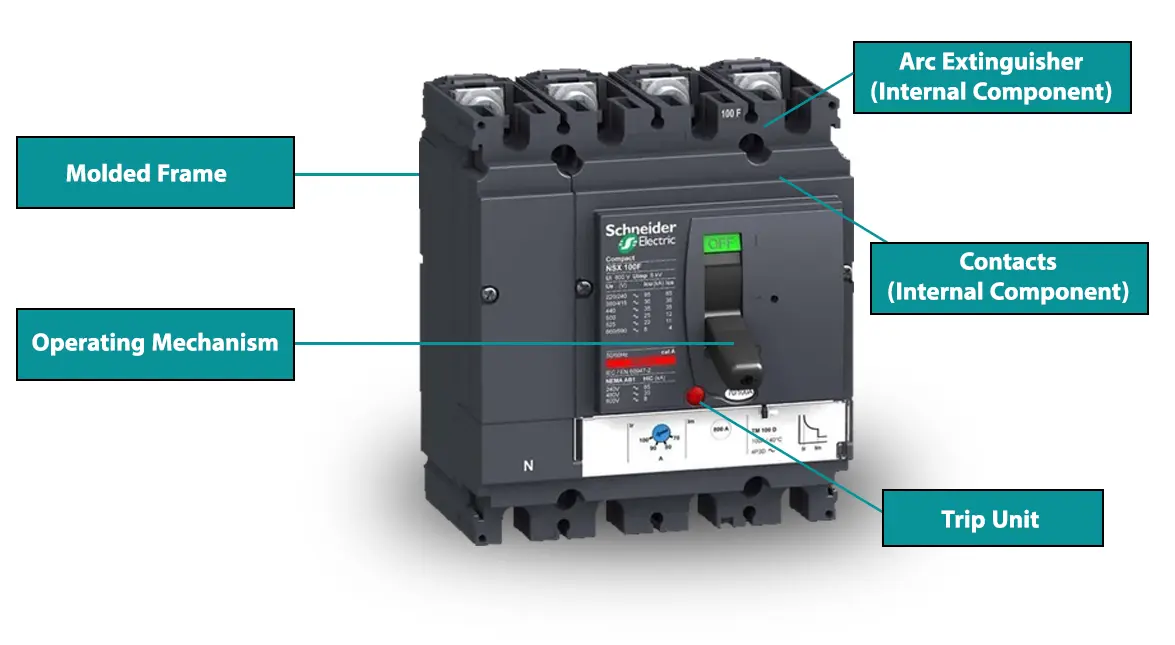
The image above shows a detailed view of a Molded Case Circuit Breaker (MCCB) with its key components labeled. Understanding these components is crucial for comprehending how MCCBs function to provide reliable circuit protection.
1. Molded Frame:
The external structure that houses all internal components. This frame is typically made of strong, durable materials to provide physical protection and insulation. The molded frame ensures that the MCCB can withstand environmental stress and operational wear, enhancing its long-term reliability.
2. Operating Mechanism:
This component is responsible for manually or automatically opening and closing the circuit. It allows for the control of electrical flow, enabling users to interrupt the circuit when needed or when an overload or short circuit is detected.
3. Arc Extinguisher (Internal Component):
When a fault occurs, an arc forms as the circuit is interrupted. The arc extinguisher safely dissipates the arc energy, preventing damage to the breaker and surrounding equipment. This is a critical safety feature in MCCBs.
4. Contacts (Internal Component):
These are the points of connection between the input and output terminals of the breaker. When the breaker is closed, the contacts allow electrical current to flow through. In the event of a fault, these contacts open to break the circuit and stop the flow of current.
5. Trip Unit:
The trip unit is the brain of the MCCB. It monitors the current flowing through the breaker and triggers the mechanism to open the contacts when the current exceeds a set limit, protecting against overloads and short circuits.
Each of these components works together to ensure the MCCB can provide reliable protection against electrical faults, safeguarding both the equipment and the users.
Types of MCCBs (B, C, D, K, Z Curve)
Molded Case Circuit Breakers (MCCBs) come in different types based on their tripping characteristics, similar to Miniature Circuit Breakers (MCBs). These types are classified according to their tripping curves, which determine how quickly the breaker responds to overcurrent conditions.

MCCB types are categorized by tripping curves, determining how the breaker reacts to different surge levels.
🔹 Type B (3–5 × In)
Very sensitive
Used for resistive loads
Trip even on small surges
🔹 Type C (5–10 × In)
General industrial use
Suitable for small motors & transformers
🔹 Type D (10–20 × In)
Handles very high inrush currents
Ideal for large motors & industrial machinery
🔹 Type K (10–12 × In)
Designed for inductive loads
Faster trip compared to D type
🔹 Type Z (2–3 × In)
Most sensitive type
Used for semiconductor equipment and precision electronics
Choosing the correct curve reduces nuisance tripping and ensures optimal protection.
MCCB Circuit Diagram — Explained Clearly
Construction and Working Principle of MCCB (Molded Case Circuit Breaker)
A typical mccb circuit diagram contains:
Line (incoming) terminals
Load (outgoing) terminals
Bimetal strip (thermal element)
Solenoid coil (magnetic element)
Moving and fixed contacts
Arc chute
Manual operating mechanism
The diagram shows how the current flows through the thermal and magnetic units before reaching the load, enabling the MCCB to detect both types of faults.
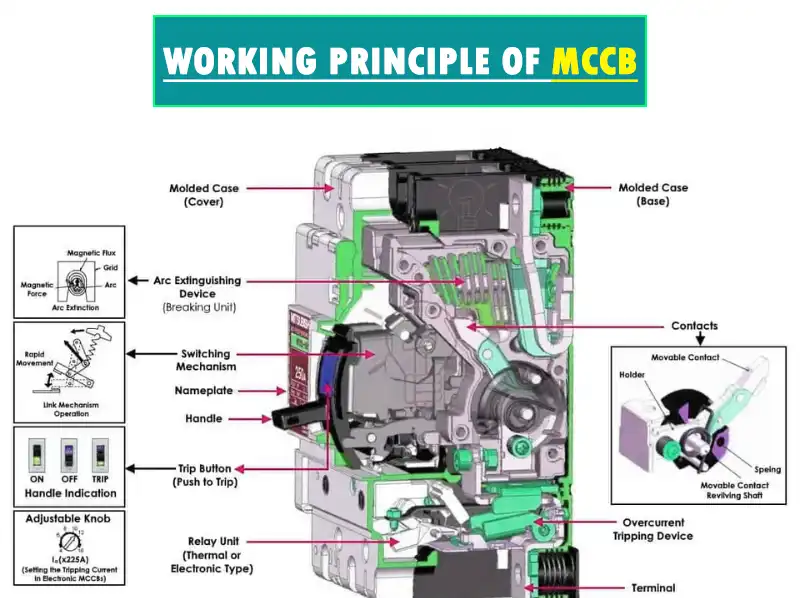
Internal Construction of MCCB (Detailed 2026 Version)
Here are the major MCCB components and their roles:
✔ Molded Case
High-strength insulating case protecting all internal parts.
✔ Operating Mechanism
Allows manual ON/OFF switching and resets the breaker.
✔ Arc Chute
Metal plates that divide and cool the arc.
✔ Contacts
Fixed contact
Moving contact
These open and close the circuit.
✔ Trip Unit
The intelligence center that monitors current.
Trip units can be:
Thermal-magnetic (most common)
Electronic / Microprocessor-based (2026 modern MCCBs)
✔ Terminals
Connect MCCB to the electrical wiring system.
Understanding the Mechanism of MCCBs
MCCBs consist of three main components: a trip unit, a current-carrying mechanism, and an arc quenching system. The trip unit is responsible for monitoring the current passing through the circuit breaker and triggering the opening of the contacts in case of an abnormal current flow. The current-carrying mechanism ensures the safe interruption of the current, while the arc quenching system extinguishes any arc that may form during the interruption process.
How do you calculate MCCB settings
To set the overload protection on an MCCB (Molded Case Circuit Breaker):
1. Determine the Rated Current (In): Identify the rated current of the MCCB, for example, 1000A.
2. Adjust the Long Pickup (Ir): Set the long pickup value to match the full load current. If the full load current is 800A, adjust the setting to 0.8 (representing 80% of the MCCB’s rated current).
3. Calculate Ir: Multiply the long pickup value by the MCCB’s rated current.
– Example: Ir = 0.8 x 1000A = 800A
This adjustment ensures the MCCB will trip if the current exceeds 800A continuously, providing effective overload protection.
Setting Short Circuit and Ground Fault Protection
1.Short Circuit Protection:
Set the magnetic trip (short circuit protection) value according to the expected fault current levels in your system. This is typically a multiple of the rated current (In).
2. Ground Fault Protection:
Adjust the ground fault settings to detect and interrupt leakage currents to prevent damage and hazards. This setting is usually lower than the short circuit protection setting.
Verifying and Testing
- Always verify the settings against your system’s requirements and safety standards.
- Conduct tests to ensure the MCCB functions correctly under simulated fault conditions.
- Refer to the manufacturer’s manual for precise instructions tailored to your specific MCCB model.
Advanced Trip Unit — How It Works
The trip unit continuously measures circuit current.
If the current exceeds the threshold:
It activates a mechanical release
The mechanism opens the contacts instantly
Modern electronic MCCBs include:
Microprocessor-based monitoring
Digital trip settings
Adjustable long / short / instantaneous trips
Ground fault protection
Communication protocols (Modbus, IoT)
These make MCCBs smarter and more accurate.
How to Calculate MCCB Settings
1. Determine Rated Current (In)
Example: 1000 A MCCB
2. Set Long-Time Pickup (Ir)
If full-load current = 800 A
→ Set Ir = 0.8 × In = 800 A
3. Set Short Circuit Protection (Magnetic Trip)
Typically 5–10 × In (for C curve)
Set according to system fault level.
4. Set Ground Fault Protection (optional)
Used in 4-pole MCCBs or sensitive installations.
5. Test & Verify
Always test settings after configuration.
Applications of MCCBs in 2026
Industrial motor control centers
Smart building distribution systems
Renewable energy installations
UPS & Data centers
Heavy machinery protection
HVAC systems
EV charging stations (modern use case)
Benefits of MCCBs
MCCBs offer several advantages over traditional fuses and other circuit protection devices. They provide better protection against overloads and short circuits, are more reliable and durable, and offer adjustable trip settings for customized protection. Additionally, MCCBs are easier to install and maintain, making them a preferred choice for modern electrical systems. To explore high-quality options, check out Schneider MCCB and Siemens MCCB solutions available in the market.
Here is a more detailed breakdown of MCCB benefits:
✔ Overload protection
✔ Short circuit protection
✔ Ground fault capability (advanced models)
✔ Adjustable settings
✔ High durability (1M+ operations)
✔ High breaking capacity
✔ Easy reset after tripping
✔ Long life span
✔ Compact and versatile
1.Protection & Safety
Overload Protection: MCCBs prevent circuits from overheating and damaging wires and equipment by detecting and interrupting prolonged excessive current flow.
Short Circuit Protection: They quickly detect sudden, high-current surges from short circuits and trip the circuit, minimizing damage and fire risks.
Advanced Safety Features: MCCBs incorporate features like arc dissipation and integral earth leakage protection to further safeguard against electrical hazards.
2.Performance & Reliability
Adjustable Trip Settings: The ability to fine-tune tripping current levels allows for precise protection tailored to specific applications and current characteristics, such as motor starting inrushes.
High Breaking Capacity: MCCBs are designed to withstand and clear significant fault currents, ensuring reliable performance even under demanding conditions.
Durability and Long Lifespan: Encased in a protective molded housing, MCCBs are more resilient to environmental factors and offer a longer mechanical and electrical life than fuses, reducing replacement frequency.
3.Design & Versatility
Compact Size: Their compact design makes them suitable for use in smaller electrical panels and crowded installations, saving valuable space.
Wide Range of Applications: MCCBs are versatile and used in various settings, from industrial and commercial buildings to heavy-duty equipment like welding machines and large motors.
Ease of Reset: Unlike fuses, MCCBs can be easily reset after tripping, providing continuous operation after a fault.
Conclusion
Molded Case Circuit Breakers (MCCBs) remain a fundamental part of electrical safety — especially with the modern demands of 2026 systems.
By understanding the mccb working principle, internal structure, tripping curves, and circuit diagram, you can select the right MCCB for any application.
Whether you are working with industrial machinery, commercial power distribution, or sensitive electronic equipment, the MCCB ensures:
Safety
Reliability
Efficiency
Protection
Incorporating MCCBs from trusted brands such as Schneider Electric or Siemens ensures optimal long-term performance.
mccb working principle pdf
To download the article working principle of MCCB in PDF format, click on the following link:
Frequently Asked Questions
What Is the Difference Between an RCD and RCBO?
✅ An RCD (Residual Current Device) provides protection against earth faults by detecting leakage currents and disconnecting the circuit. An RCBO (Residual Current Breaker with Overcurrent) combines the functions of an RCD and an MCB (Miniature Circuit Breaker), protecting against both earth faults and overcurrent (overloads and short circuits).
Why is MCCB better than MCB?
✅An MCCB (Molded Case Circuit Breaker) is better than an MCB (Miniature Circuit Breaker) because it offers higher current ratings, adjustable trip settings, and protection against a wider range of electrical faults, including overload, short circuit, and ground faults. MCCBs are suitable for industrial and commercial applications requiring higher power capacities and more robust protection, whereas MCBs are typically used for lower-power residential and light commercial applications.
How to set MCCB settings?
✅1. Identify the Rating:
- Check the rated current (In) of the MCCB to ensure it matches your system requirements.
✅2. Adjust the Trip Settings:
- Thermal Trip Adjustment: Set the overload protection by adjusting the thermal trip dial to the desired value (usually a percentage of the rated current).
- Magnetic Trip Adjustment: Set the short circuit protection by adjusting the magnetic trip dial to the appropriate level, based on the expected fault current.
✅3. Verify the Settings:
- Double-check that the settings align with your system's electrical parameters and safety requirements.
✅4. Test the MCCB:
- Conduct a test to ensure the MCCB operates correctly under simulated fault conditions.
✅5. Consult the Manual:
- Refer to the manufacturer's manual for specific instructions and recommended settings for your MCCB model.
How do you calculate MCCB settings?
✅ To set the overload protection on an MCCB (Molded Case Circuit Breaker):
1. Determine the Rated Current (In): Identify the rated current of the MCCB, for example, 1000A.
2. Adjust the Long Pickup (Ir): Set the long pickup value to match the full load current. If the full load current is 800A, adjust the setting to 0.8 (representing 80% of the MCCB’s rated current).
3. Calculate Ir: Multiply the long pickup value by the MCCB’s rated current.
- Example: Ir = 0.8 x 1000A = 800A
Contact GeeTech Group :