


XB5AA841
Manual overload reset push button, Harmony XB5, red flush, 22mm, for 17…120 mm actuation distance
- Stock status:
- Call for availability
- Manufacturer:
- Schneider
- Product code:
- XB5AA841
Main documents
Related products
| Range of product | Harmony XB5 |
|---|---|
| product or component type | Manual overload reset push-button |
| Device short name | XB5 |
| Bezel material | Dark grey plastic |
| Fixing collar material | Plastic |
| Head type | Standard |
| Mounting diamete | 22 mm |
| Shape of signaling unit head | Round |
| Operator profile | Red flush, unmarked |
| Activating distance | 17…120 mm |
| device presentation | Complete product |
| Height | 29 mm |
|---|---|
| Width | 29 mm |
| Depth | 120 mm |
| net weight | 0.027 kg |
| Resistance to high pressure washer | 7000000 Pa at 55 °C, distance : 0.1 m |
| Operating travel | 10 mm |
| protective treatment | TH |
|---|---|
| ambient air temperature for storage | -40…70 °C |
| Ambient air temperature for operation | -40…70 °C |
| Electrical shock protection class | Class II conforming to IEC 60536 |
| IP degree of protection | IP66 conforming to IEC 60529 |
| NEMA degree of protection | NEMA 4X |
| IK degree of protection | IK03 conforming to IEC 50102 |
| Standards | EN/IEC 60947-1 |
| Product certifications | UL listed |
| Unit Type of Package 1 | PCE |
|---|---|
| Number of Units in Package 1 | 1 |
| Package 1 Height | 3.0 cm |
| Package 1 Width | 4.0 cm |
| Package 1 Length | 13.5 cm |
| Package 1 Weight | 28.0 g |
| Unit Type of Package 2 | S01 |
| Number of Units in Package 2 | 30 |
| Package 2 Height | 15 cm |
| Package 2 Width | 15 cm |
| Package 2 Length | 40 cm |
| Package 2 Weight | 1.035 kg |
Product Description
XB5AA841
The Schneider Electric XB5AA841 is a manual overload reset push button from the Harmony XB5 series. This red, flush push button is designed for ease of use and reliable performance, suitable for various industrial applications.
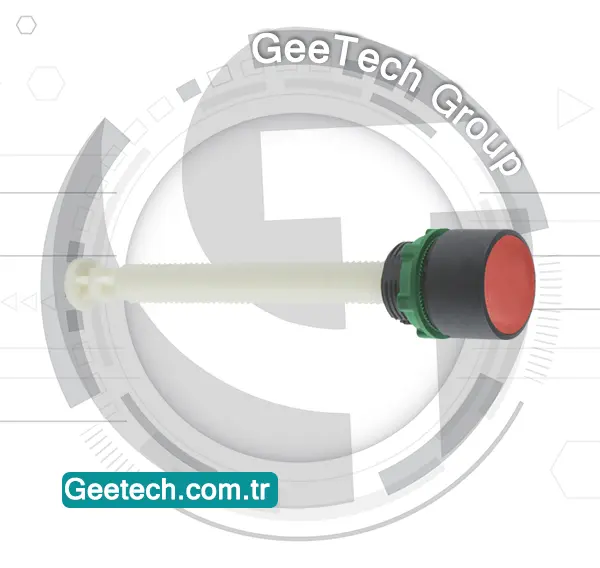
Key Features:
- Head Type: Standard, round signaling unit head.
- Operator Profile: Red flush, unmarked, providing a clear and distinct control interface for users.
- Device Presentation: The XB5AA841 is presented as a complete product, ready for immediate installation and use.
- High Pressure Washer Resistance: Withstands up to 7000000 Pa at 55 °C, at a distance of 0.1 m, making it suitable for harsh cleaning environments and ensuring long-term durability.
- Head Type: Standard, round signaling unit head.
- Operator Profile: Red flush, unmarked, providing a clear and distinct control interface for users.
- Range and Series: This push button is part of the Harmony XB5 range, known for its high quality and reliability in industrial control systems.
- Type and Design: The product type is a manual overload reset push button, specifically designed for resetting overload conditions in machinery. It features a dark grey plastic bezel and a plastic fixing collar for durability.
Summary
The Schneider Electric XB5AA841 manual overload reset push button is a robust and reliable component ideal for industrial control applications. Its durable construction, compatibility with standard 22mm mountings, and high resistance to harsh conditions make it a practical choice for professionals seeking dependable control solutions.

Frequently Asked Questions
What is a push button used for?
✅When you press a push button, it either makes or breaks an electrical connection, allowing or interrupting the flow of electricity through the circuit. Pushbutton switches are commonly used in a wide range of electronic devices, control panels, and applications where users need to activate or deactivate a function or operation. These switches are essential for ensuring reliable and efficient control in various settings, from industrial machinery to consumer electronics and automation systems.
What is NO and NC in Push Button Switches?
✅ Push button switches can be classified as either normally open (NO) or normally closed (NC). Normally open (NO) switches, also known as "OFF" position switches, complete the circuit when actuated. In contrast, normally closed (NC) switches, or "ON" position switches, break the circuit when actuated. Understanding the difference between NO and NC push button switches is crucial for selecting the right type for your application, whether it's for industrial machinery, control panels, or electronic devices.
What Are the Two Types of Push Button Switches?
✅ Push button switches come in two main types: single-pole and double-pole switches. The single-pole switch is the most common type, featuring a control device with a single input source and a single output source. This basic design makes single-pole switches ideal for a wide range of applications. Double-pole switches, on the other hand, have two input sources and two output sources, offering more complex control capabilities for advanced electrical systems.
Is a Push Button a Sensor?
✅No, a push button is not an analog sensor. An analog sensor provides a continuous output signal that varies in proportion to the measured quantity. In contrast, a push button provides a discrete output signal that changes state from one level to another when the button is pressed or released. This distinction makes push buttons ideal for applications requiring simple on/off control, unlike analog sensors that are used for more complex, variable measurements.
What is Inside a Push Button?
✅ A push button consists of several key components:
1. Button Actuator: This is the part you physically press. It is connected to an internal mechanism within the switch.
2. Contacts: Push button switches contain one or more sets of contacts, typically made from conductive materials like metal. In their default state, these contacts are separated.
When the button actuator is pressed, it moves the contacts together to complete an electrical circuit. This simple yet effective design is what makes push buttons reliable for various applications, from industrial machinery to everyday electronic devices.
Is a Push Button Digital or Analog?
✅A push button is a digital sensor. Unlike analog sensors, which provide a continuous range of values, digital sensors like push buttons have only two states: on or off. For example, when you press a push button, it changes from off to on, providing a discrete signal. Similarly, a digital light sensor can detect whether it is dark or bright, also giving a binary output. This clear distinction makes push buttons ideal for simple, straightforward control in various applications.


Reviews
There are no reviews yet.