


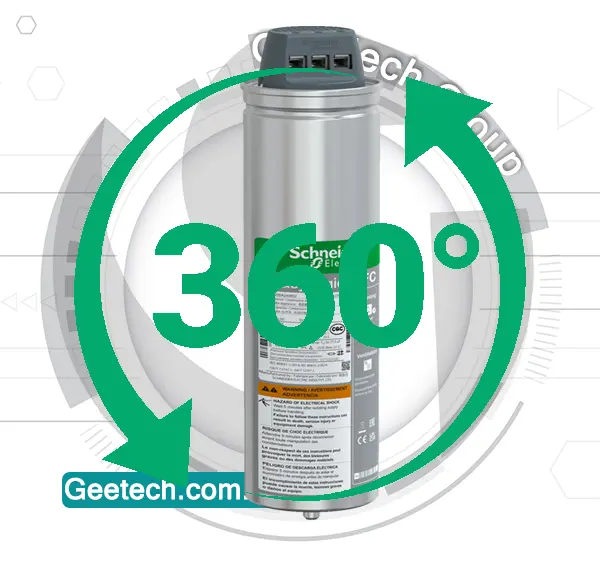
BLRCS200A240B52
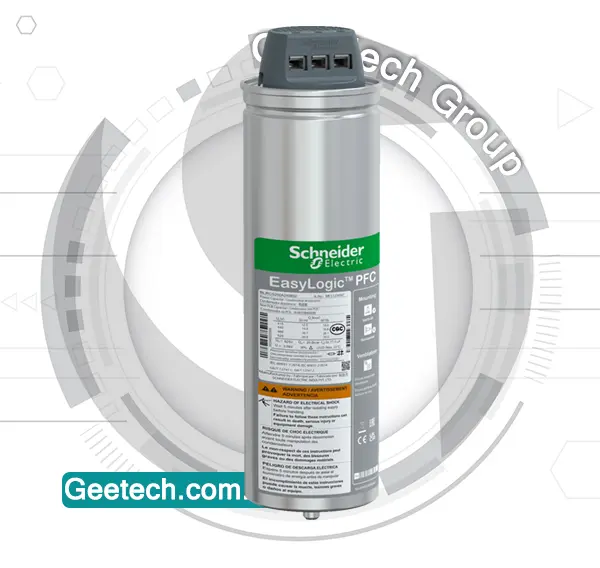
EasyCan Capacitor – 20/24 kvar – 525 V – 50/60Hz
- Stock status:
- Call for availability
- Manufacturer:
- Schneider
- Product code:
- BLRCS200A240B52
Main documents
Related products
| product or component type | Standard duty capacitor |
|---|---|
| Network frequency | 50/60 Hz |
| Series name | EasyLogic PFC Capacitor |
| Network harmonic content | <= 10 % |
| Electrical parameters | 20 kvar 525 V 50 Hz 24 kvar 525 V 60 Hz |
| Maximum permissible voltage | 1.1 x Un (8 hours over 24 hours) |
| continuous overcurrent capacity | 1.5 x In |
| Rated voltage | 525 V AC 50/60 Hz |
| Dielectric losses | < 0.2 W/kvar |
|---|---|
| Power losses | < 0.5 W/kVAr |
| capacitance tolerance | – 5 % to 10 % |
| Voltage test | 2.15 x Un AC between terminals for 10 s <= 660 V – 3 kV AC between terminal and container for 10 s >= 660 V – 6 kV AC between terminal and container for 10 s |
| Inrush current | 200 x In |
| Maximum switching operation per year | 5000 |
| Service life in hours | 100000 h |
| Dielectric material | Metallized polypropylene film with Zn/Al alloy, |
| Impregnation material | Non-PCB soft PUR resin Biodegradable |
| Type of installation | Indoor installation |
| Connections – terminals | ClampTite terminal |
| Mounting mode | Vertical |
| Diameter | 90 mm |
| Height | 308 mm |
| net weight | 2.3 kg |
| Standards | IEC 60831-2 IEC 60831-1 |
|---|---|
| IP degree of protection | IP20 |
| Operating altitude | 2000 m |
| Temperature class | D |
| Ambient air temperature for operation | -25…55 °C |
| Relative humidity | 95 % |
| Unit Type of Package 1 | PCE |
|---|---|
| Number of Units in Package 1 | 1 |
| Package 1 Height | 28.5 cm |
| Package 1 Width | 37.3 cm |
| Package 1 Length | 57.4 cm |
| Package 1 Weight | 2.3 kg |
| Unit Type of Package 2 | S04 |
| Number of Units in Package 2 | 8 |
| Package 2 Height | 30 cm |
| Package 2 Width | 40 cm |
| Package 2 Length | 60 cm |
| Package 2 Weight | 18.4 kg |
| Unit Type of Package 3 | P12 |
| Number of Units in Package 3 | 96 |
| Package 3 Height | 90 cm |
| Package 3 Width | 120 cm |
| Package 3 Length | 80 cm |
| Package 3 Weight | 264.96 kg |
Product Description
BLRCS200A240B52
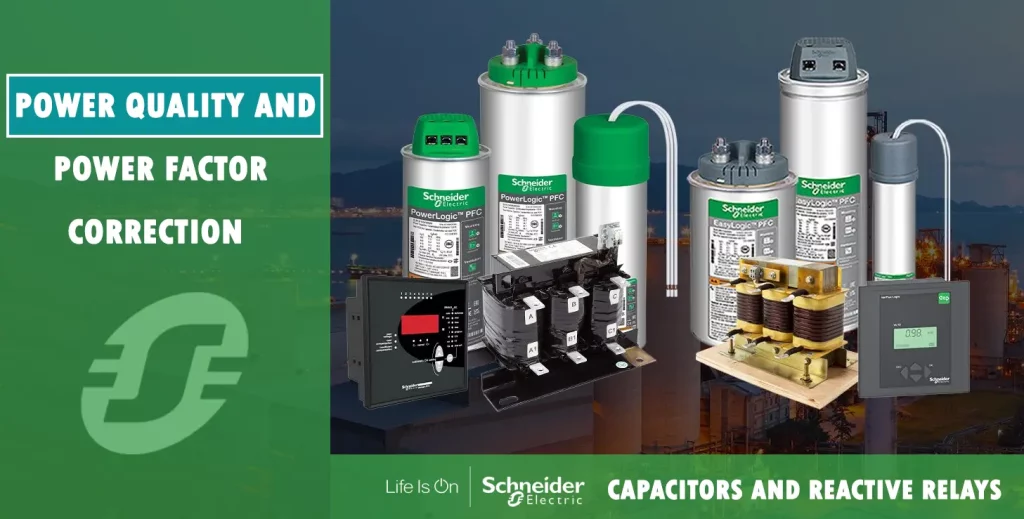
The Schneider Electric BLRCS200A240B52 is a standard-duty Power Factor Correction (PFC) capacitor from the EasyCan (EasyLogic) series, engineered for reliable performance in stable electrical networks with low harmonic distortion. Designed for general-purpose applications, it is ideal for systems with detuned reactors and minimal non-linear loads. This capacitor delivers 20 kVar at 525 V (50 Hz) and 24 kVar at 525 V (60 Hz), ensuring efficient reactive power compensation and compliance with IEC 60831-1 and IEC 60831-2 standards.
Key Specifications:
Rated Output: 20 kVar @ 525 V (50 Hz) / 24 kVar @ 525 V (60 Hz)
Rated Voltage: 525 V AC, 50/60 Hz
Continuous Overcurrent Capacity: 1.5 × In
Maximum Permissible Voltage: 1.1 × Un (8 h/24 h)
Network Harmonic Content: ≤ 10%
Capacitance Tolerance: -5% to +10%
Dielectric Losses: < 0.2 W/kVar
Power Losses: < 0.5 W/kVar
Inrush Current: 200 × In
Service Life: 100,000 hours
Mounting Mode: Vertical
Terminal Type: ClampTite terminal
Protection Degree: IP20
Operating Temperature: -25…55 °C
Weight: 2.3 kg
Technical Data:
Article Number: BLRCS200A240B52
Product Range: EasyLogic
Product Series: EasyCan
Product Type: Standard-Duty Capacitor
Standards: IEC 60831-1, IEC 60831-2
Dielectric Material: Metallized Polypropylene Film with Zn/Al Alloy
Impregnation: Non-PCB Soft PUR Resin (biodegradable)
Ambient Humidity: Up to 95%
Operating Altitude: ≤ 2000 m
Temperature Class: D
Applications:
Power factor correction in standard-duty electrical installations
Systems with detuned reactors and low harmonic distortion
General-purpose industrial or commercial power distribution networks
Energy optimization in stable, linear load environments
Product Summary:
The Schneider Electric BLRCS200A240B52 EasyLogic Capacitor provides dependable and efficient power factor correction for standard applications. With long service life, low dielectric losses, and IEC-certified performance, it ensures reliable operation in indoor low-voltage installations with minimal harmonic interference.

Frequently Asked Questions
How is power factor corrected?
✅Power factor correction is accomplished by adding capacitors in parallel with connected motor or lighting circuits. This technique can be implemented at various points in the electrical system: directly at the equipment, at the distribution board, or at the origin of the installation.
By improving the power factor, capacitors help enhance energy efficiency, reduce electricity costs, and improve the overall performance of the electrical network. Whether for industrial facilities, commercial buildings, or residential setups, integrating capacitors for power factor correction is essential for optimizing electrical systems.
What is PFC power factor correction?
✅ Power factor correction (PFC) involves a series of methods aimed at improving a device's power factor. To address displacement issues, external reactive components are commonly used to compensate for the circuit's total reactive power. Implementing PFC enhances energy efficiency, reduces electricity costs, and optimizes the performance of electrical systems. Whether in industrial, commercial, or residential applications, effective power factor correction is essential for maintaining a stable and efficient electrical network.
What is PFC capacitor?
✅ A power factor correction capacitor (PFC capacitor) is a device designed to enhance the power factor of an electrical circuit. For instance, if the circuit experiences a lagging current, it demands extra power from the supply. By installing a PFC capacitor, you can reduce this additional power requirement, thereby improving energy efficiency and lowering electricity costs. PFC capacitors are essential for optimizing the performance of electrical systems in industrial, commercial, and residential settings.
Where to install power factor correction capacitors?
✅Power Factor Correction Capacitors are versatile solutions that can be strategically deployed at various points within an electrical system. These include individual motors, distribution panels, or the main service panel. By installing capacitors at these key locations, you can effectively enhance power factor, improve energy efficiency, and optimize the performance of your electrical network.
How do you add capacitors?
✅Capacitors - SparkFun Learn
When capacitors are connected in parallel, their total capacitance is the sum of individual capacitances. This is similar to how resistors add up in series. For instance, if three capacitors with values of 10µF, 1µF, and 0.1µF are connected in parallel, the total capacitance would be 11.1µF (10+1+0.1).
How to test a capacitor?
✅How to Measure Capacitance with a Digital Multimeter
Connect the test leads to the terminals of the capacitor. Keep the test leads connected for a few seconds to enable the multimeter to automatically select the appropriate range. Once connected, read the measurement displayed on the multimeter. If the capacitance value falls within the measurement range, the multimeter will accurately display the value of the capacitor.


Reviews
There are no reviews yet.