


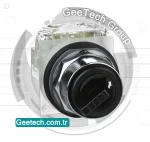
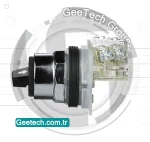
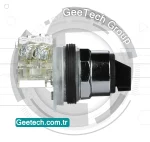
9001KS11BH13
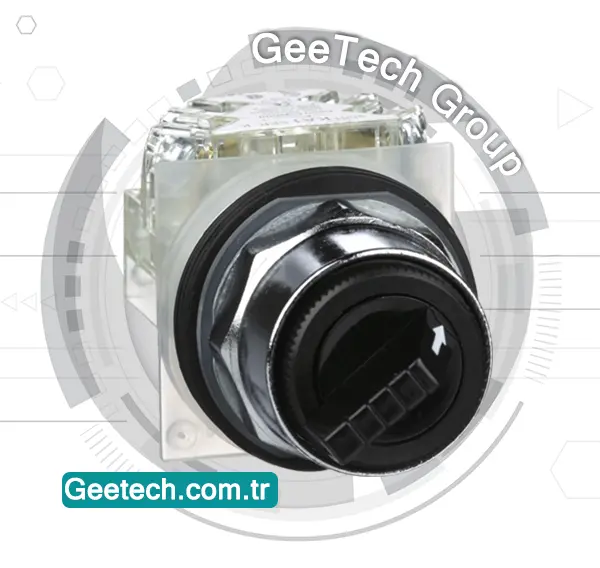
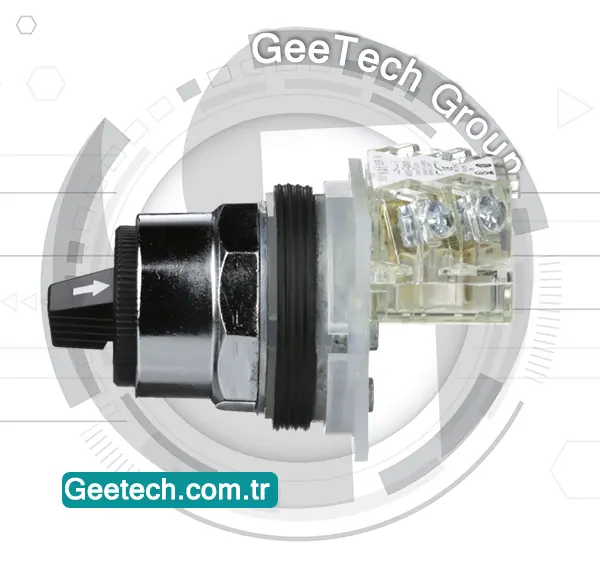
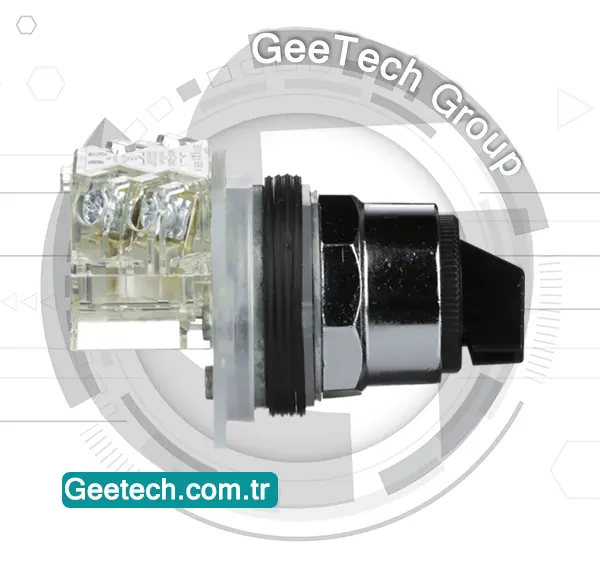
30mm Push Button, Type K, selector switch, 2 position, black knob, 1NO and 1 NC
- Stock status:
- Call for availability
- Manufacturer:
- Schneider
- Product code:
- 9001KS11BH13
Main documents
Related products
| Range of Product | Harmony 9001K |
|---|---|
| Product or Component Type | Selector switch |
| Device short name | K |
| Type of operator | Stay put |
| Operator profile | Black standard knob |
| Bezel material | Metal |
|---|---|
| Mounting diamete | 1.18 in (30 mm) |
| Operator position information | 2 positions |
| Contacts type and composition | 1 C/O |
| Connections – terminals | Screw-clamp terminals, 1 x 0.22…2 x 1.5 mm² IEC 60947-1 |
| Product compatibility | 9001KA1 side 2 |
| device presentation | Complete product |
| Cap/operator or lens colour | Black |
| Operator profile | Standard handle |
| Type of operator | Stay put |
| Size | 30 mm |
| Cam profile | 5 |
| NEMA degree of protection | NEMA 1/2/3/3R/4/6/12/13 |
|---|---|
| Product Certifications | CE CSA LR24590 class 3211 03 UL listed file E42259 CCN NKCR |
| Category | US10CS121426 |
|---|---|
| Discount Schedule | 0CS1 |
| GTIN | 785901330226 |
| Returnability | Yes |
| Country of origin | MX |
| Unit Type of Package 1 | PCE |
|---|---|
| Number of Units in Package 1 | 1 |
| Package 1 Height | 1.80 in (4.572 cm) |
| Package 1 Width | 2.20 in (5.588 cm) |
| Package 1 Length | 3.70 in (9.398 cm) |
| Package 1 Weight | 5.28 oz (149.686 g) |
| Unit Type of Package 2 | S01 |
| Number of Units in Package 2 | 24 |
| Package 2 Height | 5.91 in (15.0 cm) |
| Package 2 Width | 5.91 in (15.0 cm) |
| Package 2 Length | 15.75 in (40.0 cm) |
| Package 2 Weight | 8.54 lb(US) (3.873 kg) |
Product Description
9001KS11BH13
The Schneider Electric 9001KS11BH13 is a robust and reliable 30mm selector switch, designed to meet the demanding requirements of heavy-duty industrial applications and extreme environments. Part of the Harmony 9001K series, this selector switch features a durable metal operator base, ensuring long-term performance and dependability.

Key Features:
- Durable Construction: The 9001K series selector switches are built with a metal operator base for enhanced durability and reliability in harsh industrial conditions.
- Two-Position Selector: Offers a straightforward interface with two distinct positions, controlled via a black knob handle.
- Contact Configuration: Includes one Normally Open (NO) and one Normally Closed (NC) contact, providing versatile control options.
- Self-Grounding: Features automatic self-grounding operators that require no additional wiring, simplifying installation.
- IP66 and NEMA 4 Rated: Ensures heavy-duty, oil-tight, waterproof, and dust-tight performance without needing protective boots, making it suitable for a wide range of industrial environments.
- Wide Range of Accessories: Compatible with a variety of accessories to meet specific application requirements.
Summary
The Schneider Electric 9001KS11BH13 selector switch combines durability, versatility, and ease of use, making it an excellent choice for a wide range of industrial applications. Its robust design and compliance with international standards ensure reliable performance and safety in demanding environments.

Frequently Asked Questions
What is a push button used for?
✅When you press a push button, it either makes or breaks an electrical connection, allowing or interrupting the flow of electricity through the circuit. Pushbutton switches are commonly used in a wide range of electronic devices, control panels, and applications where users need to activate or deactivate a function or operation. These switches are essential for ensuring reliable and efficient control in various settings, from industrial machinery to consumer electronics and automation systems.
What is NO and NC in Push Button Switches?
✅ Push button switches can be classified as either normally open (NO) or normally closed (NC). Normally open (NO) switches, also known as "OFF" position switches, complete the circuit when actuated. In contrast, normally closed (NC) switches, or "ON" position switches, break the circuit when actuated. Understanding the difference between NO and NC push button switches is crucial for selecting the right type for your application, whether it's for industrial machinery, control panels, or electronic devices.
What Are the Two Types of Push Button Switches?
✅ Push button switches come in two main types: single-pole and double-pole switches. The single-pole switch is the most common type, featuring a control device with a single input source and a single output source. This basic design makes single-pole switches ideal for a wide range of applications. Double-pole switches, on the other hand, have two input sources and two output sources, offering more complex control capabilities for advanced electrical systems.
Is a Push Button a Sensor?
✅No, a push button is not an analog sensor. An analog sensor provides a continuous output signal that varies in proportion to the measured quantity. In contrast, a push button provides a discrete output signal that changes state from one level to another when the button is pressed or released. This distinction makes push buttons ideal for applications requiring simple on/off control, unlike analog sensors that are used for more complex, variable measurements.
What is Inside a Push Button?
✅ A push button consists of several key components:
1. Button Actuator: This is the part you physically press. It is connected to an internal mechanism within the switch.
2. Contacts: Push button switches contain one or more sets of contacts, typically made from conductive materials like metal. In their default state, these contacts are separated.
When the button actuator is pressed, it moves the contacts together to complete an electrical circuit. This simple yet effective design is what makes push buttons reliable for various applications, from industrial machinery to everyday electronic devices.
Is a Push Button Digital or Analog?
✅A push button is a digital sensor. Unlike analog sensors, which provide a continuous range of values, digital sensors like push buttons have only two states: on or off. For example, when you press a push button, it changes from off to on, providing a discrete signal. Similarly, a digital light sensor can detect whether it is dark or bright, also giving a binary output. This clear distinction makes push buttons ideal for simple, straightforward control in various applications.


Reviews
There are no reviews yet.